How a clean small-base breakout ran +50%, gave it all back in a semiconductor exhaustion, and produced the House Rule that makes this trade structurally impossible to repeat.
On June 12, 2026, AMKR broke out of a tight small-base consolidation in the low-$60s. Semiconductors were the leadership group. The earnings backdrop was strong (a triple-digit EPS surprise on the last print). The base was clean, the risk was defined. Intended lot type: swing. Intended initial stop: −2.5% from entry or the low of the entry day, whichever fit the setup.
The trade IDEA was correct. The trade MANAGEMENT was not.
The breakout resolved cleanly. AMKR ran from the low-$60s to roughly $79 in about ten sessions — a +20% swing gain sitting on the screen. That is exactly where a swing trader takes something. The written rule is: at +20%, peel 25%. The rule was known. It was not executed — because there was no working broker order to execute it.
Tight consolidation on the $62–64 shelf, sitting above the rising 10-week moving average. Duration was short (three to four weeks), width was narrow, volume was quiet. Textbook small-base setup.
Semiconductors were leading — the SOX index was pressing all-time highs, memory and packaging names showed relative strength, and AMKR sat inside the strongest sub-theme (advanced packaging). CANSLIM® L—letter passing.
Break above the shelf on decent volume. Ten-session run to +20%. Then extension to a peak of $96.68 (+50% from entry) on a high-volume climax day (14.8M shares, +179% of average). The first partial-sell trigger came and went unheard.
The consolidation breakout, the run to peak on the volume climax, the single-day −12.93% collapse right back into the base — and, unlabelled on the chart but overlaid on the whole thing, the two weeks of nothing that ran between the peak and the recognition.
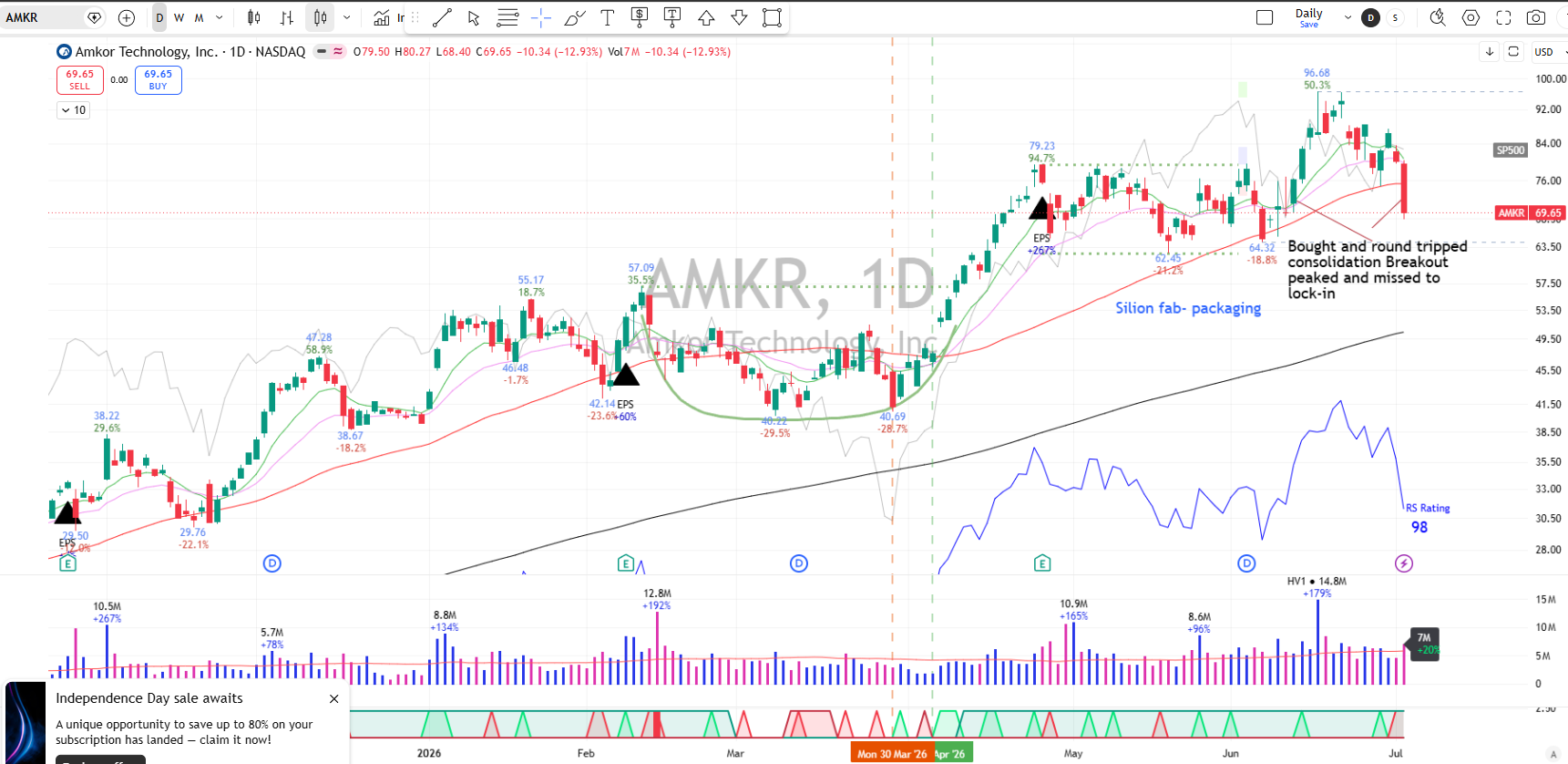
A family situation kept me away from the desk for two weeks. During that window, AMKR did three things in sequence — and every one of them was invisible to me in real time.
From $79 to $96.68. A further +22% on top of the +20% that was already there. The written rule at +20% was to peel 25% and ratchet the stop; both were unhandled.
The peak day printed 14.8 million shares at +179% of the 50-day average. That is the textbook exhaustion signature. In review it screams. In real time, it was a chart nobody was looking at.
Semis broadly ran out of buyers within the following week. AMKR collapsed −12.93% in a single session, straight back into the top of the breakout base. RS Rating still 98 — the leadership was intact; the trade wasn't.
The invariant. Nothing about that arc was ambiguous in review. In real time, none of it mattered — because the stop was a thought I was carrying around in my head, not an order sitting in the broker's book. A thought cannot exit a position while I am not looking at the screen. That sentence is the rule.
Three weeks after the trade, on July 3, 2026, I codified the Fault-Line Protocol as the first entry in the House Rules library. The full specification is on the site. What it means for a trade shaped like this AMKR one is concrete:
The point of a rule is not that it feels good on paper. The point is what it would have done, mechanically, to this specific position. Assumed entry near the top of the shelf around $64.
| Event | Price | Rule action |
|---|---|---|
| Fill (swing entry) | ~$64 | GTC stop placed at −2.5% (~$62.40) |
| First green session | ~$66 | Stop ratcheted up to breakeven |
| +5% area | ~$67 | Stop ratcheted to +2% above entry (~$65.30) — floor established |
| +20% profit | ~$76.80 | Sell 25% of position (partial 1 locked) |
| Peak + climax volume day | $96.68 | Attention lapses. Broker orders keep working. |
| Close < 8-day MA | $84 area | Sell 25% (partial 2 locked) |
| Close < 21-day MA | $76 area | Sell 50% of remaining (partial 3 locked) |
| −12.93% collapse to $69.65 | $69.65 | Floor at +2% already exited everything remaining. Position closed at gain. |
The round trip becomes a modest locked win. Not the +50% peak — nobody catches that. But nowhere close to a give-back to entry, either. That is the entire economic value of the rule.
The idea was right; the management wasn't. AMKR was a correct swing candidate on the entry day. Semis were leading, the base was clean, the fundamentals were behind it. This entry is not an argument against small-base breakouts; it is an argument for defended small-base breakouts.
The rule does not prevent round trips of the price. The stock is allowed to run to $97 and back. What the rule prevents is a round trip of the P&L. Peels lock partials. The floor exits the remainder. The chart can do whatever it wants; the account cannot go negative on this position.
Semiconductors were still leading through the give-back. AMKR's RS Rating held at 98 through the entire arc. The leadership read did not change. What changed was position management, not thesis.
No broker order is not a strategy. It is a bet against being distracted for two weeks. Some weeks that bet pays. This one didn't. The rule closes that bet permanently.
Rule 01 — the Fault-Line Protocol — was born from this trade. Every future Model Book entry that produces a new rule will cross-link the same way: story here, spec on the Rules page. Both stay in sync.
See the full House Rules library →