On August 19, 2026, Moderna gapped roughly +177% in a single day on volume it had never seen — a textbook episodic pivot. The read here is a category change, not a routine Phase 3 win. This is a live watch-thesis on a stock that could become a Model Book leader if the re-rating holds — not a completed case study, and not a recommendation.
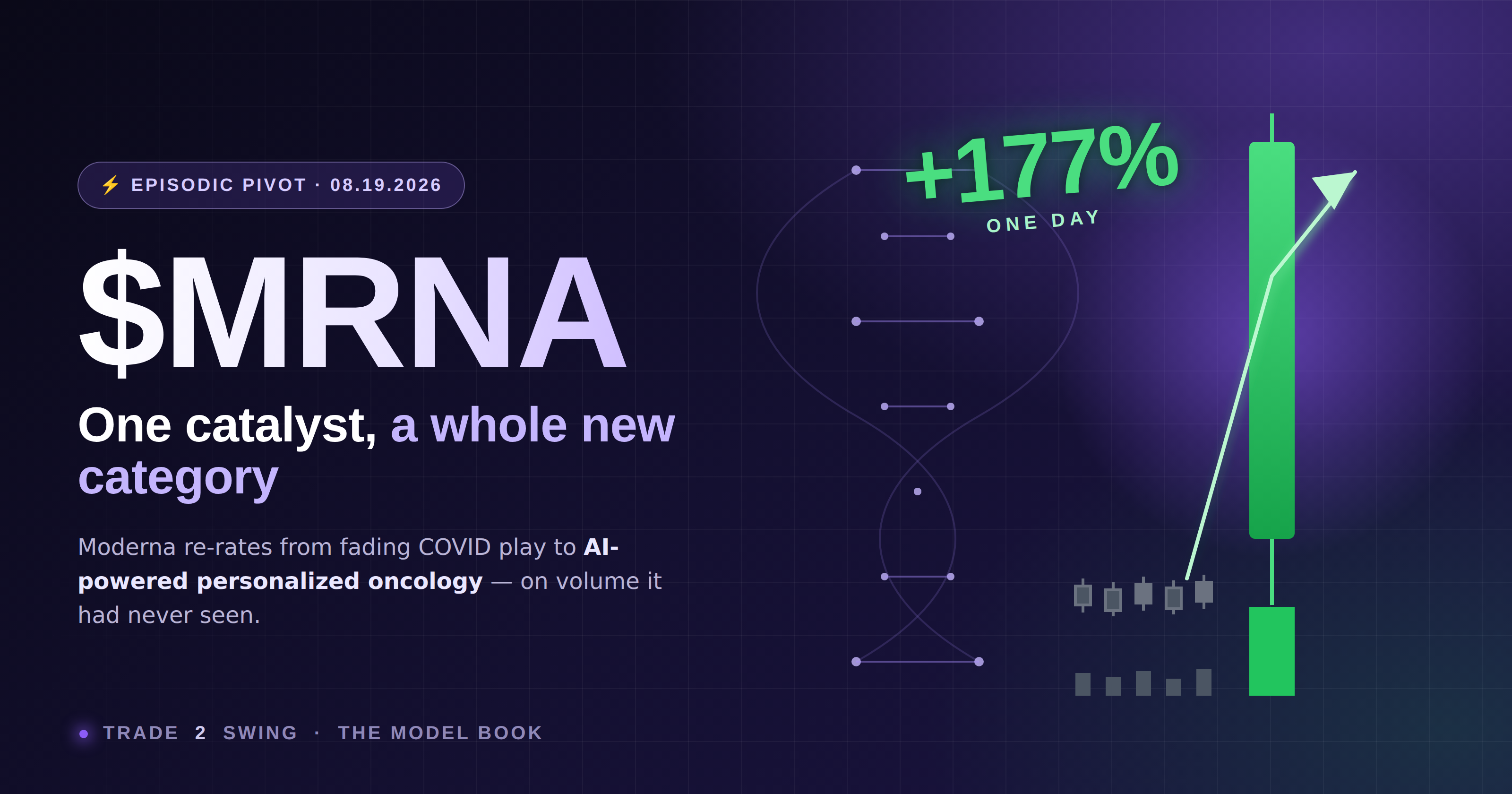
History rhymes when the market stops pricing a company for what it was and starts pricing it for what it might become. Moderna spent two years labeled a shrinking COVID-vaccine business. On August 19 that label was ripped off and replaced with a new one: a validated, AI-enabled, personalized mRNA-oncology platform. When the label changes, the multiple changes — and that is the fuel behind every true leader we study.
This entry exists to track whether the change is real. A single-day move of this size is either the first leg of a multi-fold platform re-rating, or a squeeze that busts back to Stage 1. Both paths are live. The job is to be positioned for the first while surviving the second.
Moderna and Merck reported that their personalized mRNA therapy, intismeran autogene, combined with Keytruda, met its Phase 3 endpoints in the INTerpath-001 trial — improving recurrence-free survival and distant-metastasis-free survival in patients with completely resected Stage IIB–IV melanoma.
A large late-stage success sharply raises the odds that intismeran becomes an approved, commercially relevant product — not just a research program. The single biggest binary risk moved the right way.
The bigger implication: mRNA may work as a programmable platform for personalized cancer treatment, not merely COVID vaccination. Melanoma could be the first indication, not the only one.
A skeptical shareholder base and heavy short positioning turned a fundamentally positive surprise into a violent one. Extreme participation forced covering into the gap.
What it does NOT mean. Moderna did not “cure cancer.” The trial showed the combination reduced the likelihood or delayed the return and spread of melanoma relative to Keytruda alone, in one high-risk, post-surgery population. That is a meaningful clinical result — and it is a long way from a durable, scalable, multi-cancer franchise. The thesis is about the direction of the re-rating, not a finished story.
This is not an “AI” sticker slapped on a biotech. AI does real, load-bearing work in the middle of the process — and that is what makes the platform potentially repeatable across cancers.
Your DNA is the master blueprint. mRNA is a short-lived instruction that tells a cell which protein to build. Moderna sequences a patient's tumor, finds the mutations unique to that tumor — the neoantigens — and builds a custom mRNA treatment that teaches the immune system what the cancer looks like. It does not edit the patient's DNA.
The hard problem is not finding mutations. It is deciding which 20–34 of thousands are most likely to trigger a useful immune attack. That ranking — integrating tumor specificity, gene expression, the patient's HLA type, and predicted T-cell response — is exactly the needle-in-a-haystack job that machine-learning models do. A better model picks better targets; a faster model shortens biopsy-to-dose; an automated one improves the unit economics.
Put the loop end to end — tumor sequencing → computational target selection → custom mRNA design → manufacturing → treatment → outcome feedback — and it stops looking like a drug and starts looking like a personalized-oncology engine. If that engine repeats across tumor types, the addressable market is not one melanoma asset. That “if” is the entire bull case, and it is unproven.
The reason a biotech re-rating can trade like a tech re-rating is that the market has watched this movie before. In domain after domain, AI crossed the line from “interesting demo” to “does the actual work” — and the moment it did, the winners in that domain got repriced. Drug discovery is arguably the next domino, and MRNA is the first highly visible public-market print of it landing in oncology.
Code generation and review moved from autocomplete to shipping real production work. The template for everything after: AI stops suggesting and starts doing the task.
AlphaFold collapsed a decades-long biology bottleneck — predicting how proteins fold — from years into hours, proving ML can crack problems that wet-lab brute force could not.
Perception for self-driving, route and inventory optimization, fraud and risk scoring — AI already runs load-bearing decisions across the physical and financial economy.
The through-line: once AI reliably owns the hardest selection-or-prediction step in a workflow, the whole industry re-prices around it. For personalized oncology, that step is neoantigen ranking. The question the tape is now asking is whether biotech gets its AlphaFold moment as a business — a scalable, repeatable product — not just as a paper.
Strip out the biology and this is a closed-loop, vertical AI system that crosses the digital–physical boundary: patient data in, a manufactured medicine out, outcomes fed back to make the next model better. Here is the same pipeline an engineer would recognize — and what each layer implies for where the money flows.
The IT-speak takeaway. A normal AI product ends at a prediction. This one ends at a physical, regulated medicine and a patient outcome that trains the next model. That means the real moat is the integration of proprietary data, models, mRNA design, compliant manufacturing, logistics, and outcome feedback — not any single algorithm. For the market, that is why the “AI trade” on this catalyst is a full-stack theme — compute, cloud, sequencing, tools, and bioprocessing — rather than one ticker.
Three timeframes, one story: a long Stage 1 repair, a Stage 2 turn already underway, and an episodic pivot that arrived on a volume footprint you cannot fake.
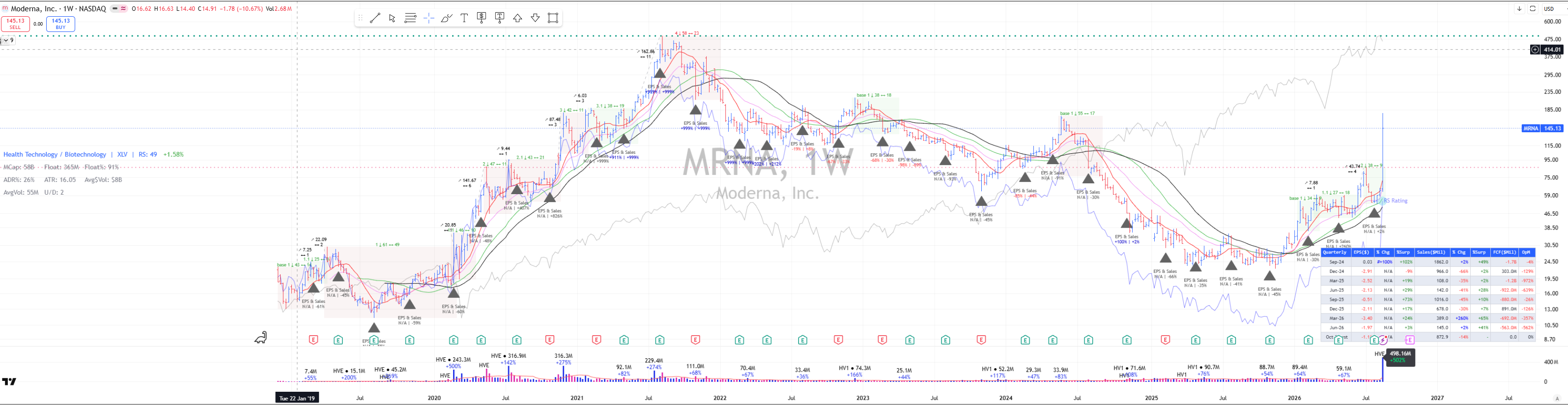
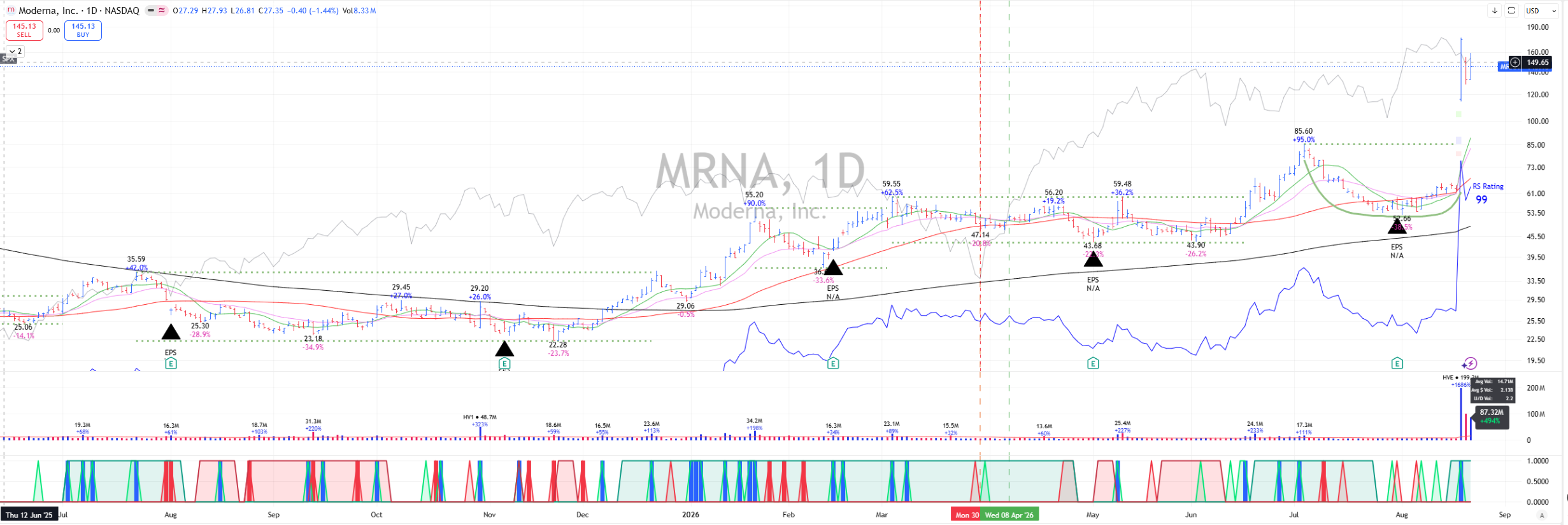
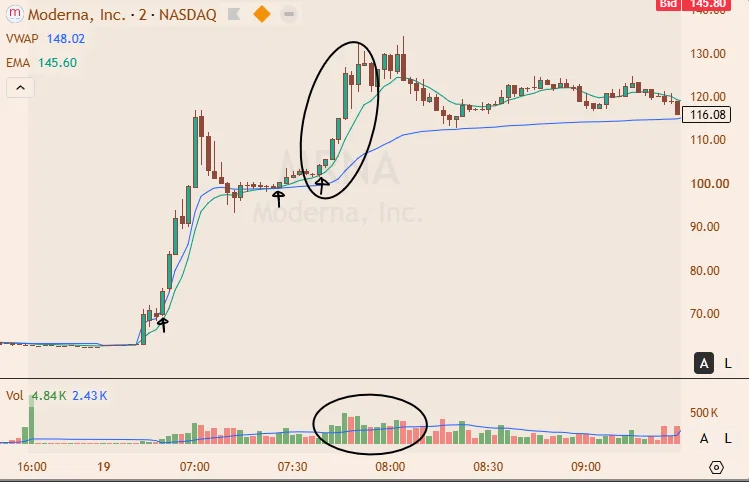
A move this large is not a conclusion — it is a question the next several catalysts will answer. Hold both of these in view at once.
If the platform thesis is real, MRNA is the first highly visible public-market proof point that AI-assisted genomic interpretation, programmable mRNA design, and automated personalized manufacturing can run as one commercial system. That reprices more than one ticker — but only in a specific order.
A catalyst this loud does not stay in one ticker. On a speculative theme, money reaches for the nearest rhymes — “AI + cancer + data” names like TEM — and bids them before any of their own fundamentals change. This is the sympathy list: names that could squeeze on the story. Treat it as a momentum watch, not a value screen.
| Ticker | What it is | Why it could run (the rhyme) |
|---|---|---|
| TEM | Tempus AI — AI precision-oncology data & diagnostics | The cleanest “AI + cancer + data” proxy on the tape — first name traders reach for on this exact theme |
| RXRX | Recursion — AI-native drug discovery | Pure “AI biotech” beta; moves hardest when the market wants the theme |
| SDGR | Schrödinger — physics/ML molecular design | Computational-design software; direct read-through to “AI designs the medicine” |
| ABCL | AbCellera — AI-driven antibody discovery | Another AI-discovery platform that trades on sentiment shifts in the group |
| NTRA / GH | Natera / Guardant — tumor profiling & liquid biopsy | They feed the sequencing step every personalized vaccine depends on |
| ARCT / BNTX | Arcturus / BioNTech — rival mRNA platforms | The most direct thematic rhyme — “if mRNA oncology is real, we own mRNA too” |
| CRSP / TWST | CRISPR / Twist — genetic medicine & synthetic DNA | Genetic-medicine and picks-and-shovels beta that ride group sentiment |
Cousins run on sympathy, not proof. Not one of these names had its own fundamentals validated on August 19. They can rip on the theme with nothing changed underneath — and round-trip just as fast when the story cools. The PDF's caution holds: MRNA validated personalized neoantigen selection, mRNA design, delivery, and custom manufacturing — it did not automatically bless every “AI biotech” ticker. Trade cousins as fast, defined-risk momentum, size them smaller than the primary, and never confuse a sympathy squeeze with a franchise.
A stock that can run multi-fold is, by definition, a stock that can also give it all back. The pre-market strength justified taking a starter at the open with defined risk — roughly 5% — but a starter without a working exit is a bet, not a position. This is exactly what House Rule 01, the Fault-Line Protocol, exists to govern.
The thesis is a sequence of proofs, not a single event. Each line below either advances the platform label or breaks it.
| Catalyst | What to watch |
|---|---|
| Detailed Phase 3 data | Hazard ratio, absolute recurrence reduction, durability, safety, subgroup results |
| Regulatory updates | Filing timing, FDA feedback, breakthrough / priority-review possibilities |
| Manufacturing disclosure | Time from tumor sample to dose, production capacity, cost per treatment |
| Commercial economics | Pricing, reimbursement, treatment-center logistics, Merck revenue-sharing terms |
| New indications | Readouts in other tumor types — the real test of the platform thesis |
| Ownership / technical | Short interest, volume persistence, institutional buying, base-building after the gap |
| COVID business / cash burn | Whether oncology upside is enough to offset legacy revenue declines and R&D spend |
Why it earns a slot in the book. Every monster we study started as a re-rating — a company the market re-categorized on a genuine catalyst. MRNA has the ingredients: a real fundamental surprise, an episodic pivot out of a base, a Stage 2 turn, monster relative volume, and a story big enough (AI + personalized oncology) to attract growth, momentum, biotech, and strategic-pharma capital at once.
Why it is a thesis, not a verdict. The bull case rests on things that have not happened yet: detailed data holding up, manufacturing scaling, and the platform repeating across cancers. Until those land, most of the sector is a theme basket, not an earnings-estimate trade — and the stock can round-trip to Stage 1 as fast as it left it.
How this entry gets promoted. If MRNA builds a proper Stage 2 base, breaks out on continued institutional volume, and the catalyst checklist keeps advancing, it graduates from watch-thesis to a full single-name Model Book profile. If it busts the pivot and loses the base, that outcome gets written up too — because a documented failure is as much a part of the book as a documented monster.
Watch-theses get updated as the catalysts land. The Watch & Ready Lists carry the current standing; the House Rules carry the risk framework that keeps a move like this survivable either way.
See the Watch & Ready Lists →